It was during these years that Lady Mabel Smith established herself as a campaigner, an advocate of adult education and as a Poor Law Guardian. It did not happen overnight. Her public life may have started in a rather conventional manner befitting a woman of her class and status but a few years into her marriage, it became clear that she did not merely attend public events as a matter of form or duty but with a deepening interest and growing commitment.
In her early married life, she continued to fulfil the role expected of her as a member of such a prominent aristocratic family. In 1902 her grandfather died and her brother, William (affectionately known as Billy), became the seventh Earl Fitzwilliam. The London Gazette reported that it had been ordained and declared by the King that the Earl’s sisters were ‘to hold the same title, place, pre-eminences and precedence as if their late father had succeeded to the title’. Whilst the Mackenzie Smiths lived their own lives at Maltby Hall, the very title – Lady – granted by the King made it publicly clear that Lady Mabel’s bonds with her ancestral family remained. In addition, given Maltby’s close proximity to Wentworth Woodhouse, Lady Mabel was close at hand and therefore still able to play her part in the Fitzwilliams’ calendar of public engagements.
As granddaughter and then as sister of the Earl, she opened bazaars, attended Sales of Work for charities including the National Society for the Prevention of Cruelty to Children (NSPCC) and the Girls’ Friendly Society (a Church of England endeavour to ‘protect’ working class girls and young women from the perceived dangers encountered in their working lives away from their families). There was nothing out of the ordinary in any of this; families of the nobility were expected to take an interest in and show support for charitable and philanthropic causes and projects, and in this the Fitzwilliams were no exception. As landowners, landlords and employers, the Earls had social responsibilities and duties towards their tenants, their employees and those in need in villages on or close to their estates. The Fitzwilliams had a good reputation for looking after people and as a result, they were well regarded and well liked locally. Lady Mabel had grown up observing the connections between the ‘big house’ and the villages surrounding it. She saw Fitzwilliams giving money to relief funds in times of acute hardship, her grandfather, for example, providing trucks of coal to the poor in harsh weather and inviting the inmates of the Rotherham Workhouse to an annual tea and entertainment at Wentworth Woodhouse.
Yet of course she also saw them hosting the King and Queen, holding summer and winter balls, hosting elaborate garden parties and dividing their time between their Yorkshire seat and their other properties and land. This was the world into which she was born and to which she showed allegiance by attending a great many official and civic events. Here I highlight just a few in which she took part in the early years of the 20th century. In 1905 she was among those of Yorkshire’s nobility to form part of a grand procession preceding the ceremonial opening of buildings at Sheffield’s newly established University. In the same year, she was part of another reception in Sheffield held for the Princesses Henry and Ena of Battenburg and Princess Beatrice of Saxe-Coburg, in the city for the unveiling of a statue of the late Queen Victoria. In 1902 she accompanied the Countess Fitzwilliam to the annual Sheffield Chrysanthemum Show at the Cutlers’ Hall as well as attending formal civic occasions at Sheffield Town Hall.

There were some occasions when Lady Mabel attended as both sister and wife; in 1907, for example, as the Lady Patroness of the Queens’ Own Yorkshire Dragoons, of which her husband and her brother were distinguished patrons, she was a guest at the Yeomanry Ball held at the Town Hall Assembly Rooms in Rotherham.
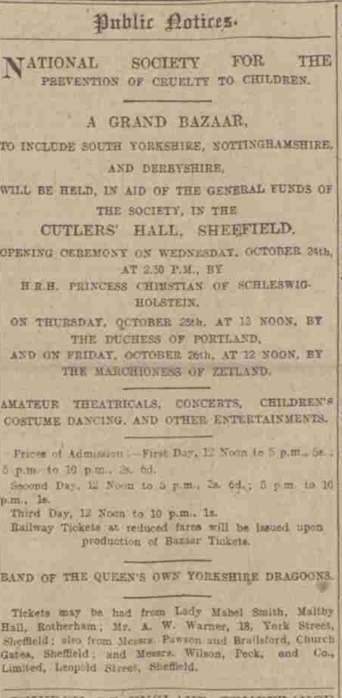
So far, so unremarkable and expected. But the evidence suggests that in this first decade of the 20th century, when Lady Mabel was in her 30s, she did not merely show up to fundraising events or lend her name as a patron. She worked hard behind the scenes to ensure their success. In 1906, a newspaper advertisement for a Grand Bazaar to be held at the Cutlers’ Hall in aid of the NSPCC stated that tickets for the event were available from Lady Mabel Smith of Maltby Hall, a pretty clear indication that her role was not just ceremonial. At the event, which raised over £2000 she was described by organisers as the ‘indefatigable honorary secretary’ who had personally written over a thousand letters, arranged for every stall present, made practical suggestions and arrangements and was, it was believed, largely responsible for the success of the bazaar. Even allowing for more than a touch of obsequiousness from those who presented her with a gift from the stallholders, it does appear that Lady Mabel took the secretary aspect of her role far more seriously than the honorary part.
During these years, however, it is not just a capacity for hard work that is noticeable in Lady Mabel’s activities. From around 1909, it is apparent that she was not merely a fundraiser but a woman seeking to understand the causes of social injustice and work out where her support was most needed. To do so, she began to align herself with those who sought ways to effect change.
In the early years of the 20th century, there was considerable and increased political interest in the causes of poverty, for so long merely regarded as an inevitable and unavoidable part of an industrial economy. Socialist parties and organisations had been growing in Britain for at least two decades, and Yorkshire played a significant part, with the formation of the Independent Labour Party in Bradford in 1893. This was followed in 1900 by the foundation of the Labour Representation Society, bringing together socialists and trade unionists and changing its name to the Labour Party in 1906. In the same year, the new Liberal Government initiated a wide ranging programme of social reform, aimed at putting in place state measures to tackle some of the effects of poverty, unemployment and ill health. These included the first state old age pension, limited sickness and unemployment insurance and the introduction of National Insurance.

The controversy surrounding the funding of these reforms sparked a major political upheaval in Britain as the House of Lords refused to pass the Liberals’ Budget Bill which sought to impose a so-called ‘supertax’ on Britain’s richest families. The result was the Parliament Act of 1911, which limited the powers of the Lords to block legislation already approved by the House of Commons. In the circles in which Lady Mabel Smith still moved, the fury of the landed classes towards the Liberal Government’s intentions – her brother, was of course, in the House of Lords – was likely to have dominated many a conversation amongst the landed gentry but it was not this class view of the new legislation that was taking up Lady Mabel’s time or energies. Although she did not declare (or perhaps fully realise) her political sympathies at this time, the evidence suggests that she was reading, thinking and forming her own opinions.
In March 1910 Lady Mabel presided at a lecture at the Friends (Quakers) Meeting House in Sheffield. This was one of a series of talks about the Poor Law and this particular one was given by Dr Marion Phillips (who became a Labour MP in 1929), an investigator on the Poor Law Commission. This was set up by the Conservative Government in 1905 to examine all aspects of the current Poor Law system, which was by then over 70 years old. After some years of detailed investigations, the Commission ended up with two reports. The Majority Report did not favour the dismantling of the Poor Law, nor in fact did it approve of state intervention in the lives of the poor. In contrast, the Minority Report, written by Beatrice Webb, a Fabian Socialist, sought to end the current system which used the Workhouse as a deterrent. Dr Phillips agreed that the Poor Law was judgmental, inadequate and punished families who fell on hard times. She explained in her Sheffield lecture that the harshness of the present system meant that children were not receiving the care they needed to make their way in the world.

Lady Mabel, when introducing Dr Phillips, said that whilst everyone bore responsibility for the development of children’s lives, there was an extra duty to see the children of the Poor Law as ‘a special charge whose future was in the hands of the people’. Now whilst there is nothing specifically socialist in her words, it is perhaps significant that Lady Mabel was at this lecture at all, that she was willing to preside at a public event delivered by a woman who was not just a contributor to the Minority Report but a member of the Women’s Labour League, which had close ties with the Labour Party. Three years later, Lady Mabel became a Poor Law Guardian herself, in a system still unreformed and to which I will return to this in my next post. For the rest of this one, here are some further examples of Lady Mabel’s continued journey into a political and social awareness that I think marked a decided shift from any notions of noblesse oblige as she moved towards a life of activism and campaigning.
A few weeks after Marion Phillip’s lecture, Lady Mabel gave a talk in Masbrough (now part of Rotherham) at the annual conference of the South Yorkshire District of the Women’s Cooperative Guild. The Guild, which arose out of the Cooperative Movement, was an organization for working class women to meet in friendship and to gain confidence in political work. Lady Mabel paid tribute to the work of the Guild in providing educational opportunities for working women to befit them for public and civic responsibilities and to do so with confidence. This was of enormous importance at a time when public office was dominated by men who had had plenty of time to learn the rules of engagement and to assume that the main roles belonged to them and would continue to do so. In the early 20th century, women were seeking greater involvement in the public sphere than they had been permitted in the Victorian age. It was of the utmost importance to have access to a good education which would fit them for more than the traditional domestic roles for so long expected of them. Lady Mabel spoke of self-improvement ‘as the best and noblest sign of national life’ and how important it was not just in readiness for public life but in the home. She told the Guild that educated women made the best mothers because they were able to communicate and express their ideas to their children. The Guild later published (I think it was later but I have not yet discovered the date) the text of a speech given by Lady Mabel entitled Education and the Workers’ Right to Live (which is part of the collection of her Personal Papers in Rotherham Archives), in which she summed up the need for education in the broadest sense of the word, fitting people for living, not merely existing. Workers, she believed, needed sufficient leisure time to allow them to develop and enjoy their talents through access to art, music and literature.
The Workers’ Education Association (WEA) was founded in 1903 to promote adult education for working class men and women. In Lady Mabel it found an enthusiastic advocate. In Sheffield in 1912 she explained to an audience the WEA belief that it was not a privileged upbringing that should be the gateway to the nation’s universities but brains and character. Through adult classes offered to working people in partnership with universities, the opportunities that had been denied to those who had had to leave school too early, could now result in what the WEA called ‘an open highway for education’. Lady Mabel worked with the Yorkshire Branch of the WEA to encourage attendance at its classes and her belief in the advantages to be gained through education and through adequate leisure time underpinned much of her work in the decades which followed this speech.
The March 1910 talk to the Women’s Cooperative Guild in Sheffield (mentioned above) highlights several useful pieces of information about Lady Mabel. She began her talk by admitting that this was the first time she had addressed a meeting ‘of that kind’, asking her listeners not to be too critical of her as she would try to do the best she could. Her meaning about this being the first time is unclear – the first time talking to an organization of women or about education? She was also, however, apologetic about her inability to express herself in the manner she would have liked, blaming this on her own education which was not, she admitted, as good as she now felt the need of. It was this, she continued, that led her to appreciate the value of education. She referred to her inadequate education on more than one occasion in the years that followed and so it is worth pausing here to question what sort of education Lady Mabel might have received as a girl and young woman.
I do not know if Lady Mabel attended school at any point in her childhood but it was relatively unusual in the 19th century for the daughters of nobility to be educated away from the home. Governesses were appointed when girls were around five years old and the education they then received depended almost entirely on the skills, confidence and teaching experience of the woman employed, with perhaps an odd extra tutor brought in to teach different subjects, including music or drawing. Towards the end of the 19th century, girls’ schooling in England was coming under greater scrutiny than previously yet the gradual improvements in standards and the broadening of the curriculum did little to alter the education of aristocratic girls. For them, things went on pretty well as they had done for generations of daughters who were lucky if their education went further than being taught their place in society, along with the necessary accomplishments to make good marriages. When Lady Mabel’s mother was in Torquay in 1881 with her children, the census shows that there was a governess within the household (Catherine Bailey’s interview with Colonel Smith’s niece also indicates that Lady Mabel had a governess). Although William (Billy) was there with his three sisters, he was only eight years old and as this was roughly the age at which sons were sent away to school, perhaps he had not yet started or was home for the holidays (Easter in that year was just a fortnight after the census was taken). Noble sons were educated to ensure that they would be able to run the family estate, enter politics or take a commission in the Army. Billy, heir to the Fitzwilliam title, did all of this. He went to Eton and then Trinity College, Cambridge before obtaining his Army commission. He toured India, served in the Oxfordshire Light Infantry during the Boer Wars and was a Member of Parliament by the time he was 22, inheriting the earldom when he was 30.
Suffrage and Equal Rights
As well as highlighting her views on working women’s education (and giving a little insight into her own education), that 1910 address to the Women’s Cooperative Guild also provides clues to Lady Mabel’s views on women’s position in society. Within her talk, she makes direct reference to the women’s suffrage movement, which, by 1910, was grabbing a great many headlines throughout the country. Lady Mabel stated that although the women in the audience did not yet have the parliamentary vote, ‘they were the wise mothers of those who assisted in that work’, making it even more important that women should be interested in the working of the State and the British constitution.
The campaign for the vote, which had been gathering momentum in the last quarter of the 19th century had, during the Edwardian years, seen the emergence of a more militant wing, frustrated by the slow progress of peaceful and traditional means of protest such as petitions and appeals. In 1903 the Women’s Social and Political Union (the WSPU), whom the press nicknamed the suffragettes, was formed in Manchester under the leadership of Mrs Emmeline Pankhurst. From the start, the motto of the WSPU was Deeds not Words, encouraging women to take direct action to draw attention to their demands. Tactics included the disruption of political meetings and ‘rushing’ the House of Commons, which involved hundreds of women trying to force their way into the Palace of Westminster. Women began to be sent to prison for acts of civil disobedience and for defying (often brutal) police attempts to deter them.
In 1910 Lady Mabel pledged money to the WSPU. She also appeared on platforms at meetings with Adela Pankhurst (one of Emmeline’s daughters and the WSPU’s Yorkshire organizer, based in Sheffield), giving assurances that she would help with the Rotherham campaign for the vote, which was about to get underway.
After 1910 the WSPU advocated and encouraged more dramatic forms of protest. There was increasing frustration with the government’s intransigence on the question of women’s suffrage. Window smashing was widely adopted and there were incidents of arson and damage to public and private property. There is no evidence at all that Lady Mabel supported this shift towards more dramatic forms of protest. In fact, many previous or potential supporters were alienated by the more extreme forms of rebellion, seeking instead to support the law-abiding National Union of Women’s Suffrage Societies, led by Millicent Fawcett or one of the many other suffrage groups. Yet in 1910, when Lady Mabel donated money to the WSPU and appeared in public with Adela Pankhurst, she cannot have been completely unaware of some of the WSPU’s acts of rebellion, particularly those in Sheffield. In 1908, Adela Pankhurst had tried to gain entry to the very grand and prestigious Cutlers’ Feast, at Cutlers’ Hall, intending to make plain her objection to the presence there of Liberal politician, Reginald McKenna, First Lord of the Admiralty. In 1909, she had been charged with a breach of the peace outside the Sheffield Assembly Rooms, where Liberal MP, Herbert Samuel, was due to speak.

Clearly, for a deferential (and often anti-women’s suffrage) press, it was much easier to report on Lady Mabel’s interest in women’s role in society if it was assumed that she was not associated with the suffragettes. In 1912 she gave a talk about the importance of an education that included home and house management and recognition of a ‘higher ideal of the duties and responsibilities of the home maker’. The Evening News remarked on her thoughtful and sympathetic contribution to a discussion of women’s advancement, which was ‘in pleasant contrast to the methods of the Suffragettes with their parrot-cry of “Votes for Women”.
My feeling is that Lady Mabel was willing enough to show support at public meetings on an issue in which she felt much sympathy but that she did not get actively involved in campaigning. She kept her word to Adela Pankhurst and appeared in December 1910 at a meeting in Rotherham Town Hall at the start of the WSPU educational campaign in the town. The meeting’s speakers, however, were not all from the WSPU; there was a Labour councillor and a member of the non-militant National Union of Women’s Suffrage Societies on the platform.
In 1913 at a public meeting at Goldthorpe Adult School, on the subject of ‘Can Physical Force be an Agency for Good?’, Lady Mabel made her views clear; she was not, she said, in favour of militant methods but she saw the benefits that women’s suffrage had brought to New Zealand (which women gained in 1894), namely an increase in women’s experience and a closer connection between their public and private lives. This matched her beliefs in the importance of women’s participation in public life and in the raising of their status in the eyes of the world as homemakers and mothers. She continued to show her support for women’s equal rights after (some) women were granted the right to vote in 1918. The fight was not over; it was 1928 before all women over the age of 21 were able to vote. In 1919 she wrote an article for The Common Cause, the newspaper of the NUWSS (now the National Union of Equal Citizenship), stating that,
If women are suitable to be entrusted with the care and nurture of infants, and the performance of all vital services to the child during the first years of its life, surely they are capable of helping to make and administer the laws that are framed for its future welfare and guidance.
This leads nicely into the next post and another important milestone in Lady Mabel’s career. In 1913 she was elected on to Rotherham Rural District Council as an independent member, a seat which also entitled her to sit on the Board of Guardians, the body which oversaw the administration of the Poor Laws. This move marked her formal introduction into public service and served as an education on matters of local government and, more crucially, into the realities of working-class lives in the area in which she lived. In this, her firm belief in the equality of the sexes was a constant feature of her work, frequently highlighted in her appeals to women to serve on public bodies and especially on Councils. Her views on women councillors, widely shared by Labour women across the country, was that women had controlled family finances for generations, that they were skilled in home management and that they could readily use those skills in Council work. They possessed such sound understanding of what made a good, practicable, family house that it was only right that they should be involved in the designing of good quality council housing. In 1926 Lady Mabel said that we ‘shall not get things right until we have women working side by side with men in every sort of public work in the country’.


