As we have seen, one of Lady Mabel’s central interests was adult education and in particular, the work of the Workers’ Educational Association (WEA) and the adult schools which were growing in popularity in the years before the First World War. At the start of 1931, despite her already considerable workload in the West Riding, she became joint warden of the Manchester University Settlement which was based in Ancoats, an industrial and heavily populated area to the northeast of Manchester’s centre . This was a residential job in which she remained until her resignation at Easter 1933. To explain her role and the possible reasons why she became involved in a project away from her home and her native Yorkshire, we first need to wind back a few years.
The principal idea behind the Settlement Movement, which began in London’s East End with the establishment of Toynbee Hall, was that middle class volunteers would live among their working-class neighbours in poor areas, helping to improve the quality of people’s lives. Men and women, often university students or graduates, lived in settlement houses (which were single sex) and helped to set up social clubs and educational classes as well as becoming involved in neighbourhood social work. The idea was to enhance and enrich the quality of life, bringing communities together and listening to ensure that what was set up was exactly what was needed, rather than what volunteers might have believed or assumed was needed.

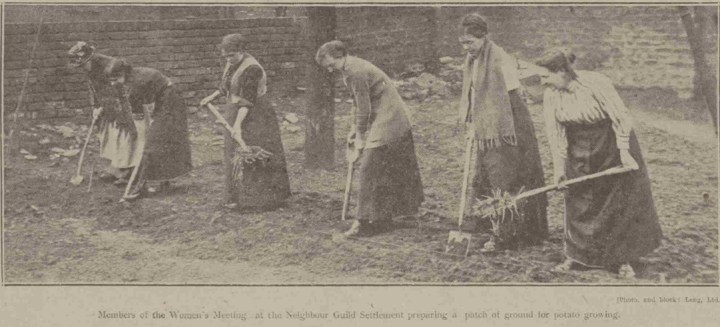
During the First World War, Lady Mabel was involved with the Neighbour Guild Settlement in Sheffield. She became President of its Horticultural Society and worked with its Women’s Group to turn a plot of land next to the Settlement House in Oxford Street into an allotment. The soil was examined by a gentleman from Leeds University who advised on the best vegetables to grow, such as potatoes (although Lady Mabel noted the show of these was rather disappointing). Lady Mabel explained that just as important as the practical and educational value of growing vegetables, was the need for beauty in members’ lives. There was to be a flower border and the women experimented to see which plants would grow best in ‘the volumes of smoke rolling across the city’. Lady Mabel offered her own advice, saying that in the coal districts it was well known that auriculas, lilies of the valley and carnations thrived in soot and smoke. Her hope was that the wartime experiment would encourage the women to seek gardens of their own which in turn would have health benefits; ‘every house’, she said, ‘ought to have a little garden’ of its own.
The Neighbour Guild Settlement was succeeded by the Sheffield Educational Settlement, based in Shipton Street in Upperthorpe. This was initially founded by the YMCA but from the early 1920s, the association between the two ceased and the Settlement, under the wardenship of Arnold Freeman, formed its own small Council, which included several influential people to direct its work and help to seek funds for its many activities. When Lady Mabel consented to join this Council in the early 1920s, she joined many people of local influence, including the Bishop of Sheffield and the Vice-Chancellor of Sheffield University. The aim of the Settlement was ‘to help to establish in the city of Sheffield the Kingdom of God’, explaining that,
By the “Kingdom of God” we mean streets along which it is a pleasure to walk; workplaces in which people enjoy working; public houses that are centres of social and educational life; kinemas [sic] that show elevating films; schools that would win the approval of Plato; churches made up of men and women indifferent to their own salvation; an environment in which people “may have life and have it abundantly”.
By “Education” we mean everything by means of which people may become more spiritual; everything that enriches human beings with That Which described in three words is Beauty, Truth and Goodness, and described in one word is GOD.
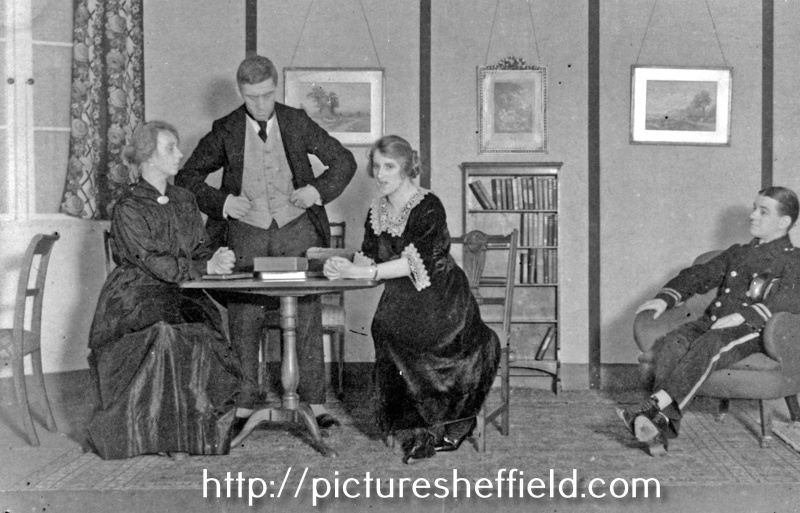
It is easy to see why Lady Mabel, who had a strong Christian faith and a belief in the value of adult education, productive leisure time and the importance of beauty in people’s lives, was supportive of the aims of the Settlement. In 1919, in a letter of endorsement, she wrote of her admiration, adding that she considered its most valuable work to be the development of a spirit of comradeship between men and women of all sections of life. The Settlement had a Literary and Dramatic Circle, putting on performances in its own ‘Little Theatre’ in Shipton Street. In addition, there were lectures, a Homecraft Club, elocution lessons and musical events.
A hundred years on, it is perhaps a tricky concept for us to understand; the notion of seeking to ‘better’ working class people with guidance from middle class volunteers with their ideas of what was wholesome and educational is an uncomfortable one, particularly with the clear spiritual message set out by Freeman. In a public letter of support in 1923 (for the Settlement was always in great need of funds), Lady Mabel pointed out how much of people’s working lives was spent alone, particularly women’s, making it very important to spend recreation and education time in the company of others. She donated money and provided goods (usually eggs from Barnes Hall) to the fairs and bazaars that were held to raise money, although in 1923, she withdrew from the Council, explaining that her local and County Council work made involvement in Sheffield very difficult (she was by now a ‘twin hatted’ councillor, for the West Riding and for Wortley Rural District Council). She remained, however, a patron of the Settlement for the rest of her life.
Lady Mabel’s decision to accept the role of residential co-warden at the Manchester University Settlement (so called because of the support and educational links provided by Manchester University) is perplexing, despite her prior involvement with the two Sheffield Settlements. She was appointed to help ease the heavy workload of the Settlement’s Warden, who, from 1926 was Hilda Cashmore. Miss Cashmore supervised Manchester University social work students living at the Settlement and working on its projects. Funds here too were always in short supply and Miss Cashmore had not engaged a bursar, the implication from the Settlement’s Council minutes being that she did the extra work herself, to save the Settlement paying a £150 a year salary to a bursar. The Council, however, decided to try and find someone with sufficient time and practical experience to lift some of the work from the Warden’s shoulders. It appears that that person was Lady Mabel Smith.
It is hard, however, to see what spare time Lady Mabel had to devote to this new role. In addition to her political work in Yorkshire, she had been voted on to the National Executive of the Labour Party at its 1930 Party Conference. This meant attending at least 20 meetings in London each year. There was also a local change; the West Riding County Council Labour Group had introduced a policy by which Aldermen had to seek re-election every six years. In 1931 they had one less space on the aldermanic bench due to losing a recent election and it was Lady Mabel who resigned. I thought at first that this might have been a deliberate move to create time for the work in Manchester. It is unlikely, however, to have reduced her workload by much, if at all, because she was, in the same year, returned unopposed as a county councillor in Ecclesfield (she was restored to the aldermanic bench in 1933) and was as committed to her duties as ever.
She was appointed to the Settlement job in the autumn of 1930, to begin work in January 1931, initially on an eight-month agreement, although this was extended and in the end she worked there for just over two years. Plans were made to convert the Library in the Settlement House in Every Street, Ancoats, into a room for her. The wardens agreed to share the £300 salary between them to avoid incurring more costs. At first Lady Mabel worked for four days a week, although this was reduced to three after the first few months, at her request. She also asked for a month off in the autumn of 1931. I wonder if this was to coincide with the Labour Party Conference which that year was in Scarborough in early October (and was the occasion of the expulsion from the Party of Ramsay MacDonald, Philip Snowden and JH Thomas for their perceived treachery in joining the coalition National Government formed to deal with the international financial crisis).
The Settlement’s Council Minutes indicate that the proposal to appoint Lady Mabel came from Hilda Cashmore, which suggests to me that the two women may have known each other, possibly through previous Settlement work or through campaigning work on adult education. By 1930 Hilda Cashmore’s work with the Settlement Movement was well known; she had founded Bristol’s Barton Hill Settlement in 1911 and became its first warden. In 1926 she became Chair of the British Association of Residential Settlements. Cashmore had also served on government advisory committees alongside some of the most prominent social reformers and thinkers in the country, such as Seebohm Rowntree and William Beveridge. In a history of the Manchester University Settlement, written in 1945, Mary Stocks, who worked in Manchester with both women, said of Lady Mabel that she was ‘ever ready to move swiftly and live strenuously’ and to divide her time between Manchester and her County Council work in the West Riding. This description certainly accords with the impression that I have of Lady Mabel as a woman who would not ask of others what she was not prepared to do herself. Without knowing anything of the circumstances, I do wonder if this attitude was also responsible for her decision in 1928 to take care of the children whose father had died. When action was needed, Lady Mabel took it, perhaps because she saw it as her duty to do so if no one else could help (I don’t know how long she looked after the children but as there are no further references to this in press articles, I suspect it was temporary, especially as she was in Manchester just a few years afterwards).
Her experience and skills were put to immediate good use in Manchester. Being a resident meant hands on involvement in all aspects of the work done within the district as well as constantly seeking funding for the many social projects undertaken. The Settlement’s work with children during the years of Lady Mabel’s residency included the running of a very popular play centre for the under tens, held most evenings and on Saturday mornings. Here, children could attend classes such as the ‘Natural Movement Dancing Class’ or they could make use of the Settlement’s children’s library. There were also holidays and camps organized during school vacations. Public donations funded these, along with trips to swimming baths and the cinema, as well as picnics and garden parties (there were offers from people in better off areas to use their gardens).
For more information about the Manchester University Settlement, you may wish to refer to this Our History | Manchester Settlement
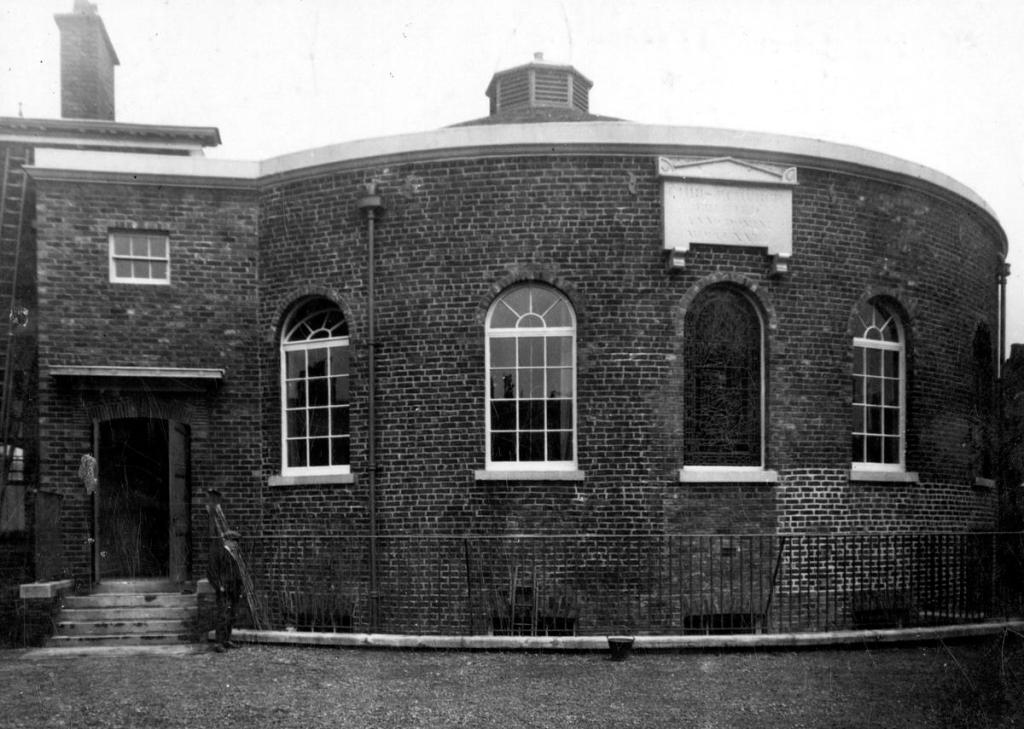
Her time in Manchester coincided with years of extremely high unemployment and in 1932, the Settlement opened a club for unemployed men. According to the Warden’s Report for 1932-3, the average attendance at this ‘Pilgrim’s Club’ was around 70 men each day. It was made clear that this was not a charitable concern; these were the years of the Means Testing of income for the unemployed and every care had to be taken to ensure that the Club was not seen to be a relief centre. The men paid two pence a week to become members and appointed their own committee to take charge of the running of the club. During morning sessions, they took part in a range of occupations from woodwork to poultry-keeping and first aid. There were games and sports in the afternoons, such as football and gymnastics. An allotment section of the Club was established on land provided by the Corporation, at a cost of four pence week for each member. This was invaluable to many struggling families as well as providing exercise and opportunities to spend time outdoors away from the house. There was a similar club for unemployed boys offering training and instruction in various types of employment, including office work and carpentry. Approaches were made to local firms which agreed to give the boys a chance of work if any vacancies came up.
There were clubs like these opening up in many parts of the country as the Depression took hold (for more information on these you might like to look at this blog on my website Family discoveries: aspects of life in 1930s Britain – Cathy Hunt historian about the centre with which my grandfather was involved in establishing in Richmond, Surrey in the 1930s) and members of the Manchester Settlement’s club visited several northern counties to talk about its work to those interested in starting up a club in their own areas.
In a book written to commemorate the 100th year of the Manchester University Settlement (1995), people who had been associated with its work were asked for their recollections. One man remembered the beginning of the Pilgrim Club, saying that
Lady Mabel (Smith) knew dad [sic] because dad was church warden at St Edwards…and knew that he was used to welfare because he had been a shop steward. Lady Mabel said, “we do need a leader”, so he started to go then. Dad was just dedicated. I think he got paid 39 shillings a week for running the Pilgrim Club. It was full-time because unemployment was in such a state that the Lord Mayor set up clubs all over Manchester and the Pilgrim Club was twinned to one in Hulme.
I think this illustrates not just the importance of the work of the Settlement but the ease with which Lady Mabel communicated with local people, a vital skill to have in a project designed to bring people of all classes together. I rather suspect too that she was very good at persuading people to take on work for which she saw a great need.
In February 1933, Hilda Cashmore and Lady Mabel announced that they would resign at Easter. Miss Cashmore, who in 1932, had taken advantage of her lightened load to go on an investigative trip to India, decided that it was in that country that her future lay. Lady Mabel continued with her work in Yorkshire.

