
As might be anticipated by any reader who has read these blogs in the order in which they appear, Lady Mabel threw herself into war work in the same way that she approached everything else. In 1916 she asked for a chance to work as a road labourer in Wortley Rural District Council but was turned down on the basis that such work was not suitable for a woman. Unsurprisingly, this decision did not deter her and by the end of the First World War, she was Yorkshire’s Chief Organising Inspector for the Women’s Land Army.
With her husband serving in France from at least 1915, Lady Mabel embarked on a bold campaign of thrift, which she spoke about at a meeting at Sheffield Town Hall early in 1916. She confessed that before the War she had never saved a penny but now she had decided that her house and establishment were too big for one person, who could well look after herself. Another newspaper reported in 1919 that Lady Mabel had indeed closed up Barnes Hall and taken a small house in Sheffield for the duration of the War. She was, she said, learning the pleasure of doing without things. The car had been put away and she was instead getting about by tram. The extra walking took its toll on her boots and she found somewhere to get them re-soled and heeled for three shillings and sixpence. She confessed that her two temptations when looking in shop windows were flowers and books but that she had resisted even these in a quest to find out just what she could do without. She was also managing her husband’s finances while he was away and putting money into War Loan and Bonds (a patriotic investment scheme) which she would have pleasure in handing over to him later on, the hope being that they made a good return. I rather suspect that the habits acquired during the War stayed with her for the rest of her life. In an extract from a diary (in her Personal Papers) recording a visit in 1936 to Hadrian’s Wall, there are references to running out of spending money, finding a shopkeeper willing to take a book of postage stamps in exchange for fruit and biscuits and managing to have just enough money to get back to Carlisle for the return train home. The interview Catherine Bailey had with a relation of Colonel Smith’s also refers to the austerity of life at Barnes Hall.
Even before Lady Mabel became involved with the Women’s Land Army, which was established in January 1917, she recognised the need for and the value of women working on the land. She led by example, withdrawing for a few weeks from her work with Rotherham rural District Council in 1916 to undertake a nine-week stint as a farm worker in Sprotborough. Later that year, Lady Mabel wrote an article about the reasons why she took the work and outlining her experiences of life for a woman on the farm. In this piece it is possible to see how Lady Mabel’s passion for welfare and education and her belief in the expansion of women’s opportunities all came together in her efforts to support the Home Front.
Firstly, she explained that as she had already been asked to help to organize women on the land, she determined to get practical experience of how much work and what types of work women could do. In addition, she wanted to prove that educated women were as capable of manual labour (despite the views of many who were doubtful) as anyone else and that they would want to get involved if there were opportunities given. Finally, she was adamant that children who were not of school leaving age should not be taken from the classroom to work on farms and she wrote that in taking up the work herself, she hoped to take the place of one such child. This was a point upon which she remained adamant, in early 1918 objecting to the recommendations of the West Riding Education Committee that children over 12 could be employed on the land. Education, she said, was a child’s right and they should not be deprived of it. She was overruled. Again, during the Second World War, Lady Mabel strongly objected to an approved scheme for elementary school children aged between 12 and 14 to be temporarily released from school to help with the potato harvest. She believed that there were older boys who could do the work and not suffer so much from an educational standpoint as the younger ones.
Once registered at the Labour Exchange, Lady Mabel explained that it had taken time to find a farmer willing to employ her because her desire to work was not taken seriously. She was eventually taken on a trial basis and later discovered that the farmer had not expected her to stay beyond a week. She, however, was determined to show what she was capable of, getting up at 5am on her first day and getting stuck into wash day. Out on the land she began with potato riddling (the sorting and sieving of the crop), working alongside women who had worked all their lives as farm labourers. Lady Mabel said that she was at first treated with ‘kindly tolerance’ but that a ‘bond of union’ developed as they all had husbands, sons or brothers in the War. She also noted that ‘they obligingly moderated their language in my honour and I acquired an extended vocabulary of the finest Yorkshire’.
Other duties included growing mangolds (for animal feed), weeding and haymaking. At the end of her stint, she was more convinced than ever that much, ‘if not all’ farm work could be done by women because of their conscientious approach to work. Her stay at the farm ended due to the illness of a relative (the implication being that, like so many women, she was needed for personal care and nursing) although this was by no means the end of her association with women’s work on the land during the War.
By 1917 Lady Mabel was helping the Women’s War Agricultural Committee to recruit women to work on the land, looking for suitable accommodation for them and organizing training. In June 1917 it was reported in the press that Wentworth Woodhouse was set to become one such training centre, using a wing offered by the Earl and Countess Fitzwilliam. The idea was that women and girls would first spend three weeks at a designated training or ‘school’ farm and then come to Wentworth Woodhouse to complete their training and await positions of employment. It was suggested that the women might be able to stay on in the wing and use it as their living quarters once they had begun work. I would be very interested to know if either of these plans were put into action.
All opportunities to find women to work the land were taken; in the summer of that year an advertisement in the Shefield Daily Telegraph asked farmers seeking extra workers to contact Lady Mabel at Barnes Hall. The advert drew farmers attention to ‘a supply of School Teachers’ who were available in the summer holidays to help.
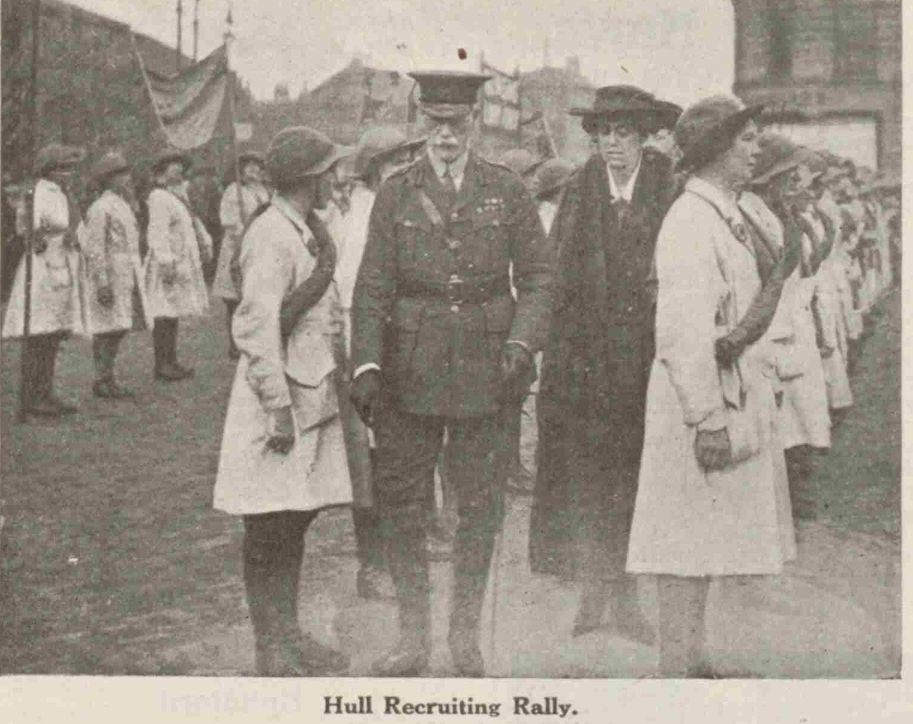
Lady Mabel’s efforts made it inevitable that, on the forming of the Women’s Land Army, she would work with that organization. By 1918 she was its Chief Organising Inspector for Yorkshire, touring the county, heading recruitment rallies in its towns and cities, in the full Land Army uniform of breeches, knee length tunic, boots and leggings (women were also given a mackintosh, jersey and a soft felt cloche hat). She talked to potential recruits about the work and gave information about wages, which at 18 shillings a week minimum (or the agreed district rate, whichever was highest) were lower than many other forms of women’s war work, such as munitions. Around 23,000 women worked full time for the Women’s Land Army during the First World War, compared with hundreds of thousands of women who worked in industry.
The description of the uniform and the statistics are from the research carried out by the Women’s Land Army website)
When the War was over, Lady Mabel served on the executive committee of the West Riding’s National Association of Landswomen. She continued to develop her interest in agriculture, speaking at Sheffield University in 1920 about the importance of townsfolk recognizing the value of farm labourers and trying to understand the way they worked instead of looking down their noses at them. She believed that agricultural workers were growing in strength and organization. In 1923 she went to Norfolk to support agricultural labourers who were on strike in protest at proposed cuts in their wages alongside increased working hours. Wages were already extremely low and there was a good deal of support for the thousands of strikers. Labour Leader Ramsay MacDonald became involved in the strike negotiations and after five weeks, the dispute ended with the farmers’ proposals abandoned.
Barnes Hall Farming
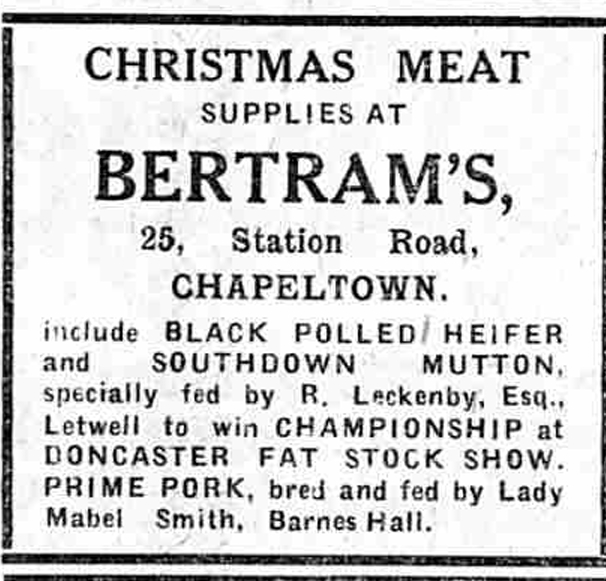
In the years after the War, as well as her work on the West Riding County Council Agricultural Committee, Lady Mabel found time to work on the farm belonging to Barnes Hall. She had returned there after the War and her husband Colonel Mackenzie Smith, who was awarded the Distinguished Service Order in 1917, joined her when he was demobilized in the spring of 1919. Although my study of Lady Mabel is about her public work, I think it is relevant to mention here her personal involvement with farming, which was as committed as everything else that she did. In 1923, she was elected as the first president of the Sheffield Pig Breeders’ Association. Bertram’s Butchers in Chapeltown, Sheffield, was among establishments selling the prime pork, bred and fed by Lady Mabel Smith of Barnes Hall. When the Smiths sold the farm in 1924, there was considerable interest at auction in the pedigree pigs owned by Lady Mabel, one of which had won prizes at the Yorkshire and Penistone shows.
I do not know why the farm was sold – the Smiths continued to live at Barnes Hall after the sale of the farm – but the Conservative candidate for Penistone, Colonel Hodgkinson, attempted to make political capital out of it during the campaign preceding the 1924 election, by suggesting that Lady Mabel (who was in the audience) had given up farming because the Labour Government had failed to bring any benefits to the land and its workers. This argument failed to convince, however, and Labour won the seat in Penistone.

