In March 1919 Lady Mabel Smith became the first woman to be elected to the West Riding County Council and she did so as a Labour member, representing the Division of Ecclesfield, (to the NW of Sheffield and at that time not part of the city). Barnes Hall, where she and her husband now lived – and remained for the rest of their lives – was within the ward and there they were well known and well regarded.
1919 marked the start of a long association with the Labour Party for Lady Mabel. She remained on the County Council until not long before she died in 1951, serving on many different Committees, including Education, Housing, Public Health, Finance and Agriculture. She became an alderman for the first time in 1927. In addition to her County Council work, she was an elected Labour member of Wortley Rural District Council from 1922 until 1934, serving also as a Poor Law Guardian. She was a well-known figure in the Labour Party at both regional and national levels and in 1930 she was voted on to the Party’s National Executive for the first time, a position she occupied again from 1932 to 1935.
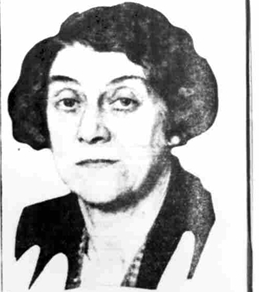
More than once, it looked likely that Lady Mabel would stand for Parliament as a Labour candidate. In 1923 she was nominated by Ecclesfield Labour Party for the Penistone Division but was not selected. This was followed by press rumours that she was expected to become a candidate somewhere in the south of England, although this never happened. In 1927 Lady Mabel gave provisional consent to be nominated to be the candidate in Sowerby Division (in West Yorkshire), turning down an invitation from Richmond (North Yorkshire) to stand there. In the event, in 1928 she declared herself unable to accept the Sowerby nomination, publicly explaining that this was because she had recently taken charge of three fatherless children and therefore would not have time to commit to the work. Whilst I have not delved into this, I cannot think that it would have been a permanent arrangement, for her life in the early 1930s became even busier than usual (see Blog Post Six). There was no further talk of parliamentary seats after this.
Largely because of her position and her title, but also because of the relative novelty of women speaking in male dominated spaces, many of Lady Mabel’s attendances and speeches at Labour Party meetings and events were noted by the press. This ensures that there is a wealth of detail in newspapers on which to draw when seeking to determine the direction her work took.
Why Labour?
Lady Mabel was no stranger to the County Council, having been a co-opted (non-elected) member of the Education Committee since before the War but her decision to stand in 1919 as a Labour candidate seems, on the face of it, to be a new departure for her. It does, admittedly, seem an unlikely move for an aristocratic woman, whose brother was, until his move into the House of Lords in 1902, a Tory Member of Parliament and one of the biggest landowners in the country. Yet, when we take a closer look at Lady Mabel’s background, as well as her lifelong work, and the issues with which she was most deeply concerned, her decision appears perhaps less surprising.
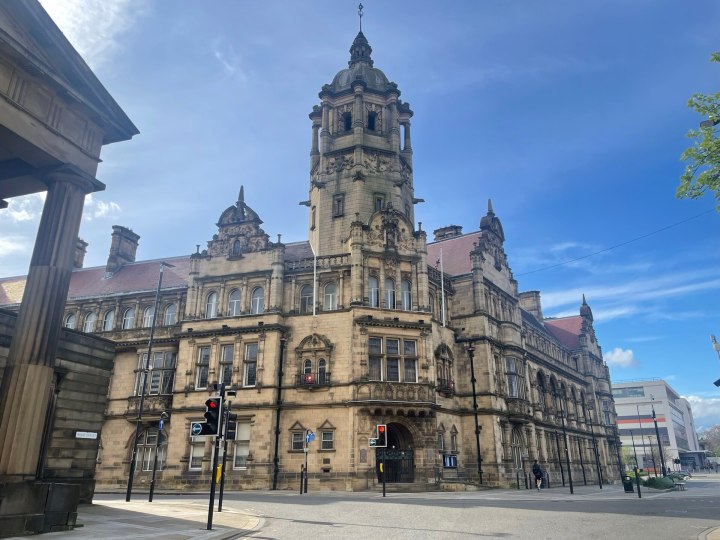
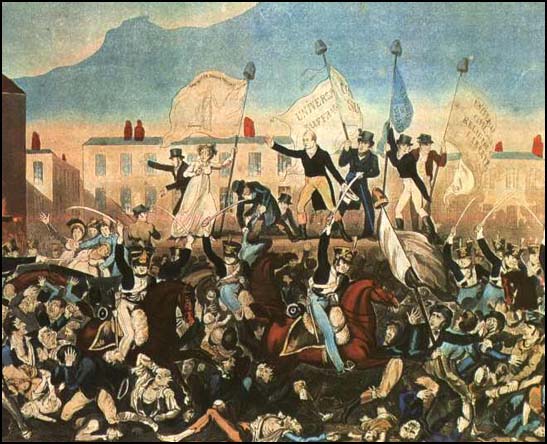
In many ways, Lady Mabel’s membership of the Labour Party was a natural gravitation to a party that was rising at the same time as the Liberal Party was losing its position as Britain’s second largest party. Both her grandfather and her father had been Liberal MPs (many large aristocratic families were of Whig/Liberal tradition) and Lady Mabel spoke publicly of her family’s Liberalism. On one occasion, she explained that an ancestor was denied the privilege of serving as the Lord Lieutenant of Yorkshire because he had chaired a meeting protesting at the savage treatment of people gathered in St Peter’s Fields in Manchester in 1819. They had gone there to hear speeches about democracy and parliamentary reform but after magistrates ordered the arrest of some of the speakers, the Yeomanry rode into the crowd, killing at least 18 and injuring hundreds of men, women and children.
In a speech about the country’s deepening coal crisis in 1926, Lady Mabel highlighted what she called a once vital connection between Labour and Liberalism, although by now, she told her audience, the Liberals ‘had neither aim nor programme’. Despite her commitment to socialism, I think this is an acknowledgement of the Liberal Party’s radical past, including its once strong connection with the miners before the rise of the Labour Party.
When asked once why she had chosen to stand as a Labour councillor, she explained that the Labour Party’s policy and outlook coincided more nearly with her own than those of any other Party. A former chairman of the County Council implied as much when speaking of Lady Mabel upon her death in 1951. Sir Bernard Lomas described her as being of ‘socialist persuasion’, but largely, he thought, because she felt that there was so much to be done to improve the lives of women and children in the county. She was aware of adverse reactions to her political sympathies; in 1927 she told a meeting that ‘some people are surprised that I am in the Labour Party because it is not considered quite nice’ but she was, she explained, already a socialist when she joined the Party.
At another Labour gathering, she said that it was largely through reading Philip Snowden many years before that she had become a socialist. She did not know anyone, she said, who had such a grasp of figures and such a knowledge of finance as Snowden (Snowden became Chancellor of the Exchequer in the first Labour Government in 1924). As a Christian, she may also have admired Snowden for his early writings on the links between Christianity and socialism. Christian Socialists believed that Christ’s teachings were an ethical basis for equality and social justice, underpinning all socialist ideals. In preparation for a lecture, Lady Mabel wrote that ‘it is Socialism which seems to me to be the practical expression of our Christianity’ and certainly both faith and socialist ideology were at the heart of all of her work.
Lady Mabel had sufficient freedom, independence and wealth to enable her to pursue her own interests thoroughly. Just as her remarks about Snowden give the impression that she always made sure she was well informed, she determined to make sure that she understood the realities facing those she represented in her work. For example, in 1938, she spoke of her belief that an extra year at school was necessary to adequately prepare children for work in coal mines. She explained that she made a point of going down a coal mine every year, to see the conditions and to keep abreast of improvements. Whenever anybody talked to her about mines, she always asked them if they had been down one. If they replied no, ‘then I tell them they have no right to talk about what they have never experienced and I change the subject’. This was typical of Lady Mabel; she knew she did not have direct experience but believed that it was her duty to educate herself in order to offer as informed an opinion as possible.
Lady Mabel did not attempt to hide or deny her class difference. She shared much in common with Labour members committed to a more equitable society in which there would be good housing, health care and education accessible to all. Addressing a meeting in 1921, she said that she did not recognise class distinctions and ‘was concerned neither with leavening down nor raising up [and] concerned only with marching forward’.
She was also adamant that despite accepting Labour’s invitation to stand for the West Riding County Council, she knew she could not adequately represent working people because she had no personal experience of the conditions of their class. She was, she insisted, merely ‘holding the door open until there came along other people who could’. By this, she did not mean that there were insufficient working people capable of doing the job, but that they had not as yet been afforded too few opportunities to do so.
It was, I would argue, a mark of her strength of character that she was bold enough to stand up for what she believed was right, despite possible opposition from her family. It is, for example, well known locally that during the six-month long miners’ strike following the General Strike of May 1926, the Earl and Countess Fitzwilliam erected marquees in order to cook and provide meals for the children of the miners who worked in their pits. There is no doubt that, as we have already seen, the Fitzwilliams assumed significant responsibility for the welfare of the workers who dug their coal. Their help was of undeniable importance to the health and well-being of families who found themselves in dire need. But what Lady Mabel, the Labour Party and trade unions sought was an end to the entire system that depended on the individual paternalism of local coal owners. Miners did not want to feel grateful for handouts in times of crisis; they wanted a living wage and an industry that treated them with fairness and respect.
As the crisis in the coal industry loomed in 1926, Lady Mabel defended the miners, who were facing wage reductions and an increase in working hours. At a Labour Women’s meeting, held just days before the General Strike began (when the miners were locked out by the coal owners for refusing to accept more wage cuts), Lady Mabel said that miners and their families could not possibly live on wages any lower than those they now received. This was no exaggeration; miners’ wages were extremely low and falling. She wanted people to understand that low wages for miners meant low wages for all other workers in the country and unless they all stood with the miners in their hour of need, ‘your own turn will come quicker than you imagine or realise’. She went on to explain her support for nationalization, not just of the coal industry but of the land; minerals, she said,
…had formed in the earth without any help from the landowners. Without the work of the miner, it was, moreover, useless. Whoever heard of a royalty owner helping to bring coal to the surface?
Housing
The issues with which Lady Mabel was most involved – at least those about which most of her speeches were reported – were largely the ones that dominated so much of life in the inter war period and filled the political agenda. Recessions in the 1920s and the Great Depression of 1929-32 led to high unemployment, short time working and wage reductions, particularly in Britain’s traditional industries, tipping more and more families into poverty. In West Yorkshire, for example, the three major industries – coal, engineering and textiles – all experienced severe slumps in the 1920s and 30s. Adequate health care remained out of reach for too many working-class people and infant mortality was stubbornly high in many areas. Making life even harder for families was a severe housing shortage and the need for local authorities to provide good and affordable council housing remained of enormous importance throughout the interwar years. In 1921 Lady Mabel spoke of her belief that the housing situation ‘was the fundamental evil of the present time’, with insanitary conditions and overcrowding causing ill health. If housing was better, she said, the hospitals would be far less full.
Early on in her first term at the County Council, her passion and fury about poor housing landed her in hot water. Talking in the mining village of Denaby Main in 1920, she sought to explain to the community that it bore responsibility for any new housing built in the village, meaning that they should object to housing that was substandard and inadequate. She warned against housing like that built in the 19th century by the Denaby and Cadeby Colliery Company. Are you going to see, she asked the audience, streets, open courts and all the other horrors which there are here, perpetrated again? She went further;
It must be difficult, and nearly impossible, to bring up your children under proper moral conditions. I don’t think there is a tree within sight at Denaby. However you can bring up children at all in such surroundings surprises me.
Her speech caused not just surprise but deep annoyance in Denaby Main village, which had defended itself some 20 years earlier from a Christian newspaper which had declared it to be not just ‘The Worst Village in England’ but a ‘hell upon earth’. Although improvements had been made since, there were still houses relying on shared privies in courtyards which had no sewage pipes. This caused multiple threats to public health, particularly in summertime; Lady Mabel recalled the time she had seen a cart carrying refuse from the privies pass underneath a washing line, dirtying the clean clothes as it did so.
Denaby and Cadeby Colliery Company brought an action of slander against Lady Mabel, its lawyers arguing that she had deliberately sought to interfere with the company’s endeavours to attract more miners to come to Denaby Main. Lady Mabel was adamant that her intention had not been to criticize any one company but to emphasise the importance of collective action in a community to improve conditions for the future. She said that she had not wished to infer that Denaby was much worse than any other place or that it was ‘hopeless’. She was fined £5 and ordered to pay costs. This was a relatively small sum but sufficient to show that the judgement upheld the colliery company’s insistence that, as a well-known woman in the area, her views were likely to carry considerable weight and influence.
There is no way of knowing what impact, if any, the outcome of this case and the publicity surrounding it, had upon Lady Mabel. She was, however, supported in her action by the West Riding Labour Group so she knew that she was not entirely isolated. There were no further slander cases but she continued to speak her mind all her life even if it meant going against the zeitgeist. In 1950, aged 80, she announced her intention to serve on the reception committee of the Sheffield Peace Congress. This conference, to be held at Sheffield’s City Hall, was convened by the British Peace Committee, which was regarded by the Labour Government as communist-led. Labour announced that attendance was ‘incompatible with membership of the Labour Party’, but Lady Mabel, who had spoken many a time on the necessity of peace during the 1930s, was not willing to be told what to do on a matter so fundamental to her beliefs. Despite her long years in the Labour Party, she was threatened with expulsion, although in the end, her local party (Penistone) decided against taking any disciplinary action against her.
Peace
That international peace was of the utmost importance to Lady Mabel is evident from her Personal Papers, held at Rotherham Archives. She was a firm believer in the League of Nations, set up after the First World War to promote international peace and to improve the health and working lives of the world’s population. In a 1923 speech in Elsecar, she referred to peace and disarmament as ‘practical Christianity’ and more than a decade later, she was still defending the League, which was being undermined in the face of rising fascism. Her speech preparation and notes explore how peace is always undermined by fear and by threats. What most of us say, she wrote, is that we want peace but that other people won’t let us have it so we must prepare for war [whereas] surely preparing for peace means giving up war.
The specific role that women could play in international peace was stressed by many Labour women during the 1920s and Lady Mabel’s lecture notes refer to the importance of women’s work in international politics. Women of all nations, she wrote, ‘have the same needs, ideals, hopes and fears’. In the 1930s, her views were closely aligned to the Labour Party’s views on the need for continued co-operation with the League of Nations in pursuit of the notion of Collective Peace and the raising of living standards across the world.
Schools and Education
Lady Mabel is probably most associated with the work that she did on the Education Committee of the West Riding County Council. Its records show that she was a co-opted member from at least 1916, perhaps due to her known connection with the Workers’ Education Association. The County Council faced significant challenges in the years after the First World War, striving to make sure that there were enough secondary school places to cope with the impact of the raising to 14 of the school leaving age in 1918. It also sought ways to provide secondary education to those children whose parents could not afford to pay fees and it became the Education Committee’s policy to give scholarships to all pupils who scored 60 per cent or above in the county examination. By 1931 just over 70 per cent of those pupils attending secondary schools did so with scholarships.
The Committee’s agenda, however, was broader than just the provision of school places and included a commitment to opening new child welfare centres, to ensure that all children, from birth, received the best possible start in life. Lady Mabel firmly believed that putting the child before the system was essential. She said that in the past, the State, with all its emphasis on compulsory education, had paid too little regard to the early life of the child. Welfare clinics sought to promote good health and they offered practical training for parents in how to best care for their children. Speaking in 1927, Lady Mabel said that ‘what has been good enough for the past generation is not good enough for the present, as times have changed and the pace of life is very different’.
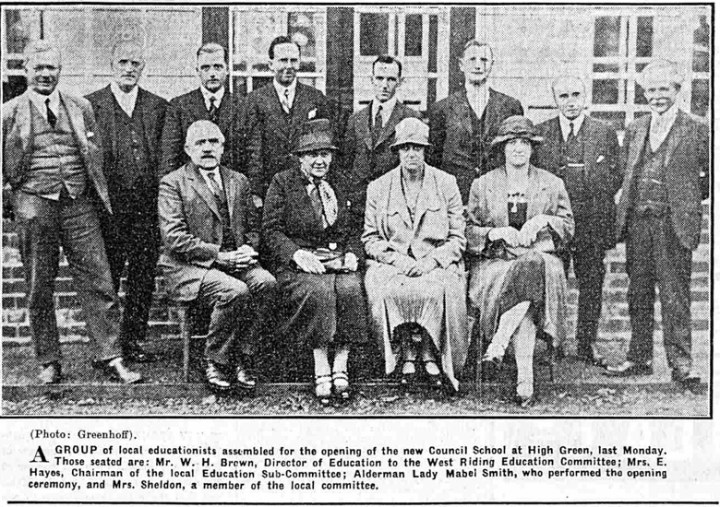
Most of the welfare centres were housed in existing accommodation such as village or church halls, but in 1937, Lady Mabel was at the opening of a new combined school and welfare centre in Sprotborough. This, Richmond Hill Council School and Child Welfare Centre was the West Riding’s first purpose-built centre, where the child’s well-being was considered from its first attendance, right through to the provision of green, open spaces surrounding the classrooms and playgrounds. This concept of child centred education may seem familiar and even obvious to us today, but the idea of planning schools with such holistic considerations for children’s welfare was fairly new in the interwar years. When, for example, a new elementary school was built in Rotherham in 1928 to accommodate rising population, it was done so with an asphalted playground, playing fields and with the school buildings on the ‘right side of the Colliery so that the prevailing winds would carry away the smoke and grime’. At its official opening, Lady Mabel quoted educationalist and nursery pioneer, Margaret McMillan, that a school ‘should be a place which the children never wanted to leave’.
Her involvement in education was, as in everything she did, thorough. When she died in 1951, it was noted how much she would be missed at Woodhouse Grammar School in Sheffield, at which she had been the Chair of Governors for nearly 30 years. At the school’s speech day in 1939, she summed up her definition of education (after again drawing attention to her own, much regretted, lack of education), which I have summarised as follows;
Thinking for oneself and sticking to one’s views; training of character, body, mind and soul; fitting each child for the future best suited to them; learning how to use and enjoy leisure time. The real value of sport was to be able to compete in games whilst being the best of friends away from the playing field; learning to have faith and courage in one’s self.
This, I think, clearly shows Lady Mabel’s belief in and commitment to the children of the West Riding. At the same speech day, tribute was paid to the role she had played in ensuring that, no matter how poor their circumstances, they would still be able to attend secondary school.
Lady Mabel’s role in the opening of Ecclesfield Grammar School in 1931 for 330 pupils was acknowledged by those who attended its official opening ceremony, one commenting on how, ever since Lady Mabel had come to Ecclesfield, she had taken them all by storm by her solicitude for the welfare of her neighbours. She was of course not solely responsible for bringing the project to fruition (and had worked with a Conservative councillor to press the case for the school) but her commitment continued with her chairmanship of the school governors. In the opening speech, Lady Mabel quoted writer and philosopher Herbert Spencer, saying that ‘education is to fit us for complete living’. She told the audience that although the need for the school was first recognised in 1920, it had taken another five years before the land was purchased by the County Council (largely due to the constraints of post war austerity).

Her commitment to making sure that children received the best possible education was one of the reasons why, in 1933, she opposed an Education Committee report which declared that the employment of married women teachers was ‘unwise on educational grounds’. Despite the 1919 Sex Disqualification (Removal) Act, women had no entitlement to keep their teaching jobs once they were married. This ‘marriage bar’ was applied in many professions in the interwar years but was robustly challenged by women who, like Lady Mabel, believed in equality of opportunity. Surely, she argued, it was an education committee’s job to find the best teachers for schools; she had never yet had it proved to her that a woman became a worse teacher when she got married. Married women, she insisted, had the same right as all other citizens to do the work for which they were most fitted. Despite her opposition (and that of seven others), the Report was adopted by the County Council. The resolution was that the case of each married woman teacher would be reviewed on its merits but that, if in the opinion of the Council, no personal hardship was likely to be felt, the contract would be terminated. In the future, it was agreed that all married women teachers in the service of the County Council would be reviewed annually. Whilst it stopped short of the immediate sacking of all married women teachers, there were still councillors who did not think the measures went far enough. Similar arguments went on in town halls across the country, with Labour women doing all they could to defend married women teachers against the charge that they ought to step aside and let their jobs be taken by unemployed male teachers, particularly during the Depression years. In 1944 the Education Act ended the marriage bar in teaching, providing justice for women certainly, although the change was due in no small measure to a national shortage of teachers. And equal pay for teachers would take yet another decade to become law.

