
On Tuesday January 28th 2025, I was in Coventry for the unveiling of a blue plaque which commemorates and honours Alice Arnold. It was a moving ceremony in which union officials and Coventry’s Lord Mayor paid tribute to Alice’s lifelong determination to make life better for the people of her city. This year Coventry’s Lord Mayor is a woman and, as Alice was in 1937, Councillor Mal Mutton is supported in her duties by a Lady Mayoress, her sister, Margaret. Alice devoted her life to trade unionism and to those she served as a city councillor and alderman (between 1919 and 1955) and so it is entirely fitting that the plaque was secured thanks to the efforts of Unite the Union and Coventry City Council.

The plaque is situated in Short Street where Alice lived when she became Coventry’s first woman mayor in 1937 and is just a short walk away from the Council House on Earl Street. The siting of the plaque, however, has further significance. The houses on Short Street are some of the earliest council housing built by Coventry City Council in the opening years of the twentieth century. Alice, who as a young woman had experienced the impact of poor, insecure housing, campaigned for better living conditions for all. There is yet more. Today, Unite the Union has its Coventry District Office on Short Street and, through a series of mergers and name changes, Unite is a direct descendant of the Workers’ Union for which Alice was a member, a shop steward and a paid organiser.
How wonderful that the Unite Community Branch, which holds its meetings in Short Street is now named after Alice Arnold. Alice was involved in initiatives in the 1930s to expand the work of trade unions beyond the workplace and to emphasise the importance of the union in the life of the community.
For anyone who would like to read more, I have written about Alice Arnold before on this website here and also here. The short biography below is reproduced (with permission kindly granted) from a leaflet I prepared for the Coventry Unite Community branch which includes an overview of Alice’s life.

Alice was born in Coventry over a hundred years ago but she remains an inspiration not just in the trade union world but in the city in which she lived and worked. A worker, a trade unionist and a community activist, Alice cared deeply about the lives of working-class men, women and children who faced daily challenges which she understood only too well herself. She spoke up for people with no voice and she stood shoulder to shoulder with Coventry citizens in the fight for fairer pay and better living conditions.
Alice was born in Coventry Workhouse at the top of Gulson Road on January 19th 1881. Workhouses were places of last resort for those who had nowhere else to turn. They provided shelter but little in the way of compassion, understanding or comfort for those in need. Alice spent the first year of her life there with her mother and siblings and even when they were able to leave, the family continued to experience hardship, living in areas of poor, overcrowded and insanitary housing. Alice’s parents were both in low paid work and, as was the case for many poor families, it is likely that their children went out to work from the earliest possible age – combining schooling with part time factory work – to help make ends meet.
As a young woman in the years before the First World War, Alice found employment in one of Coventry’s cycle factories. Bosses got away with paying women workers very low wages and this led to unease amongst men who feared that their wages were being undercut. What was needed was a strong trade union movement to ensure fair pay for all. Alice became a member of the Coventry branch of the Workers’ Union, which campaigned hard to recruit men and women working in the city’s factories. During these early years of the 20th century, Coventry, like many other working-class towns and cities, was an exciting place to be involved in labour politics, with outdoor meetings at factory gates and street corners and frequent speakers to inspire men and women to get involved in making life better for ordinary folk.
During the First World War (1914-18), many of Coventry’s factories converted to the production of military equipment and armaments and it found itself at the very centre of the nation’s war effort. With so many men away in the Army, the country relied heavily on women to produce munitions. Thousands of women came to Coventry to carry out this work and trade unions like the Workers’ Union recognised the importance of representing and protecting women in this vital but dangerous employment. Alice Arnold was herself a war worker; the cycle factory where she worked before the War now produced fuses, shells and ammunition. Alice became such a reliable and effective shop steward for the Workers’ Union that in 1917, she was taken on as a full time union organiser with responsibility for women workers. It is testimony to her dedication that she was still remembered over half a century later by women who had worked during the War, who recalled not just her organising skills but her straightforward manner and her compassion. Not only did she champion women, she helped them to fight for what was rightfully theirs. This was essential because employers often made it as difficult as possible for women to obtain the rate of pay they were entitled to. One woman remembered Alice as ‘a wonderful person for working women…it was her really, she fought for the rate’. Another woman recalled Alice’s ‘really down to earth speeches’ at the factory gate, spoken as a worker and as a citizen who understood the daily struggle of women’s lives. She was one of them, she knew their struggles because they were also her struggles.
During the War the number of women trade unionists in Britain increased significantly but there were tough challenges to face after the War and women still had a long road to travel down towards full acceptance in the industrial workplace – and an even longer path towards equal pay. Coventry workers faced many challenges during the 1920s and with the Workers’ Union, Alice continued to support families dealing with unemployment, lay-offs and low pay. Trade union membership fell considerably during these difficult years and in 1931, Alice’s employment with the Workers’ Union came to an end as the union merged with the Transport and General Workers’ Union. This came as a bitter blow to a woman who once said that her heart and soul were with the labour movement. Her work in the city, however, was by no means done.
In 1919 Alice had become a Coventry City councillor. She and Ellen Hughes were the first women to be elected to the Council and they joined the Labour bench, working tirelessly towards the city’s first Labour administration. When this was achieved in 1937, Coventry’s first woman mayor was Alice Arnold. This was a fitting tribute to a woman who had devoted so many years to looking after the city’s workers and their families. In the years following the First World War, there was a great need to focus on the next generation, to make sure women had good maternity care and that there was decent housing for families so that children could thrive. Alice served on the Council for over 30 years and her continued determination to speak up for social justice ensured that she became a well-known and popular figure in the city.
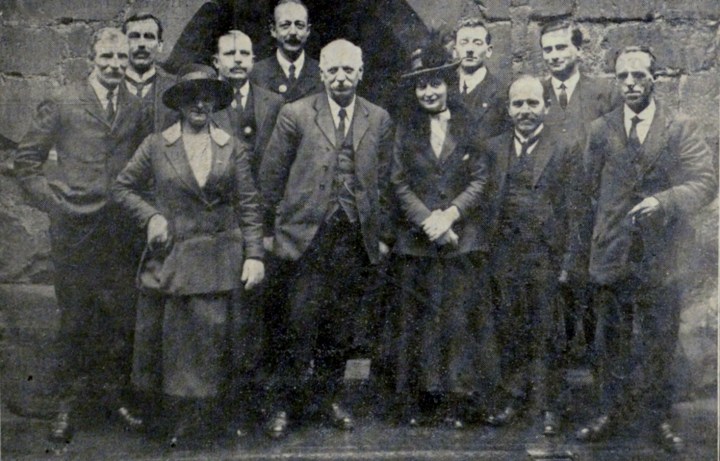
Alice Arnold died in Coventry in 1955. She spent her whole life campaigning for others. Those who knew her were struck by her many acts of kindness within the community. Her popularity was evident in 1931 when she lost her union job. Friends and colleagues rallied to find her work that would allow her to continue with her Council duties and they helped her to open a small greengrocer’s shop in Lower Ford Street, Hillfields. Later, she was employed by the Co-operative Society.
Alice Arnold fought for better wages and conditions for workers. She stood up for women war workers. She spoke on behalf of Coventry citizens for decent housing, good public health and excellent education and her life reminds us of what can be achieved if we work together for equality, fairness and justice for all.
Earlier in this blog, I wrote that Alice continues to inspire and I hope that the blue plaque will encourage many more people to learn about her life and work. I would like to end by explaining how Alice has inspired me.
I first heard of her when I was working as a tutor to the Coventry Women’s Research Group (WRG). This incredible group of women researched and wrote a book entitled Redressing the Balance, examining the lives of women, past and present, who lived and worked in Coventry. I contributed a chapter on Alice Arnold and, some years later, for another WRG book, a second piece which looked at Alice’s union work during the First World War. My fascination with Alice grew into a PhD study on women in trade unionism and municipal politics in the interwar years which in turn led to many more years of research on women Labour activists in early 20th century British trade unionism. None of this would have happened if I hadn’t been so impressed by the story of Alice Arnold and by the battles that she fought.
As I stood looking at the blue plaque, in the quiet moments after the unveiling, I recalled another Short Street incident. In the late 1990s I interviewed a woman who remembered living in Short Street as a child. Her father had TB and Alice Arnold used to come down from her upstairs flat to bring ‘best’ butter and eggs for the patient. She also brought oranges, apples and nuts for the children’s Christmas stockings. When the family of seven moved to a larger home, Alice offered to look after the youngest child on moving day. Small acts of kindness remembered for over half a century. This plaque stands not just for pioneering and politics but for humanity.
Alice Arnold 1881-1955

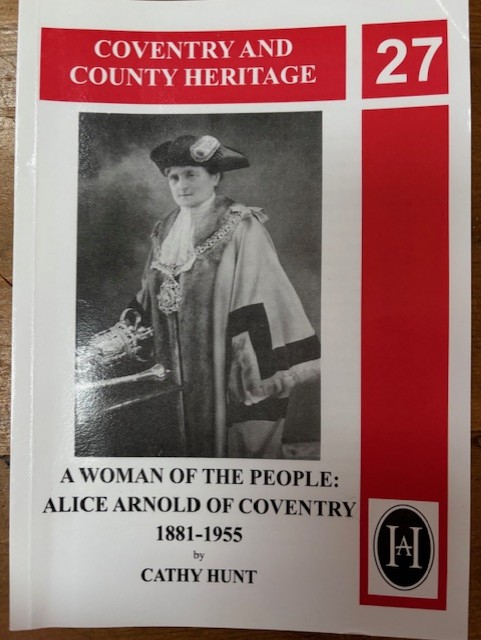
If anyone wishes to read the booklet I wrote about Alice Arnold for the Coventry Historical Association (2008), I believe the Coventry Society and the Coventry History Centre both have some copies available.
 Cathy Hunt historian